

Introduction
There are many ways to see Cape Town.
From the summit of Table Mountain. Along the curves of Chapman’s Peak Drive. Across the vineyards of the Cape Winelands or from a yacht anchored in the Atlantic.
Each offers its own perspective.
Yet none quite compares with lifting quietly above the city, watching familiar landmarks rearrange themselves beneath you, and realising that Cape Town was designed as much for the sky as it was for the ground.
A helicopter flight is often described as an activity.
It is better understood as a change in perspective.
Some Landscapes Were Meant to Be Seen From Above
Cape Town has always been a city defined by geography.
Mountains rise directly from the ocean.
Beaches disappear beneath towering granite cliffs.
Vineyards stretch towards valleys framed by distant peaks.
On the ground, these landscapes reveal themselves one at a time.
From the air, they become a single composition.
Within minutes of departure, the city transforms into something entirely different.
Roads become delicate ribbons tracing the coastline.
The Atlantic shifts through shades of turquoise and deep blue.
Table Mountain no longer dominates the skyline-it becomes part of a much larger masterpiece.
It is a view few people ever forget.
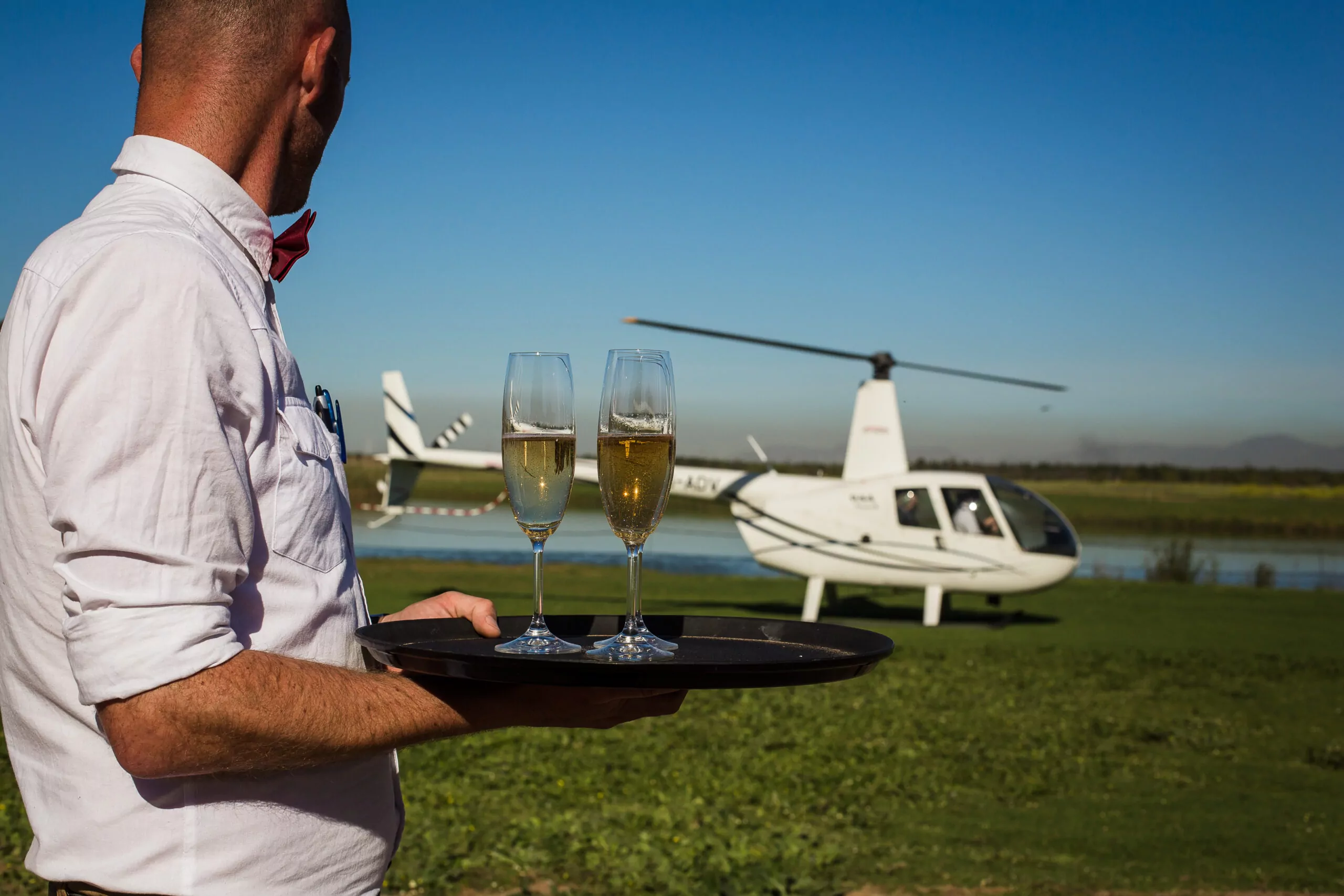
The Difference Between a Flight and an Experience
Many scenic helicopter tours follow a familiar formula.
Take off.
Circle Table Mountain.
Fly past Camps Bay.
Return to the Waterfront.
The scenery is extraordinary.
The experience, however, can feel surprisingly predictable.
A privately arranged flight begins differently.
It begins with a conversation.
What interests you most?
Is it photography?
Architecture?
Marine wildlife?
The dramatic meeting of mountains and ocean?
Perhaps the objective is simply to experience Cape Town quietly, without interruption.
The route is shaped around the guest rather than a timetable.
That difference changes everything.
The Atlantic Seaboard at Golden Hour
If there is one time to fly, it is when the afternoon begins to soften.
As the helicopter climbs away from the V&A Waterfront, the city gradually gives way to the Atlantic coastline.
Green Point.
Clifton.
Camps Bay.
Each beach catches the changing light differently.
Below, waves wrap themselves around enormous granite boulders polished smooth over centuries.
Luxury villas appear almost hidden within the mountain.
The Twelve Apostles stretch endlessly towards Hout Bay.
From above, the coastline feels less like a city and more like a painting.
The restaurants people remember most are rarely the ones with the loudest reputation. They’re the ones where they never once looked at the time.
— Beyond Cape Lifestyle ManagerFollowing Chapman’s Peak From the Sky
Few roads enjoy the reputation of Chapman’s Peak Drive.
From behind the wheel, every bend reveals another breathtaking viewpoint.
From the air, something unexpected happens.
The road almost disappears.
Instead, attention shifts to the landscape surrounding it.
Steep sandstone cliffs plunge directly into the Atlantic.
White surf curls around isolated beaches inaccessible by road.
Fishing boats leave Hout Bay as tiny white trails spread across the ocean below.
The perspective transforms one of the world’s great coastal drives into something even more remarkable.
A Peninsula Surrounded by Two Oceans
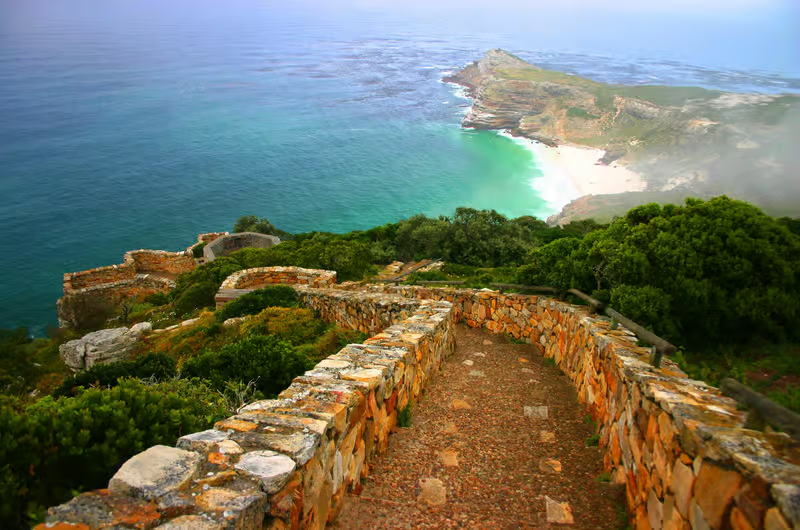
Continue south and the Cape Peninsula begins to narrow.
The mountains soften.
The coastline becomes increasingly wild.
Nature reserves replace neighbourhoods.
Beaches stretch for kilometres without interruption.
Eventually, the peninsula reaches its dramatic conclusion.
Cape Point.
Seen from above, the famous headland feels entirely different.
Rather than a single viewpoint, it becomes part of a rugged landscape shaped by wind, ocean currents and time.
The meeting of sea and mountain appears almost untouched.
It is difficult to imagine a more fitting end to the continent.
Wildlife You Never Expect
Every flight is different.
Some offer unexpected surprises.
Southern Right Whales migrate along the coastline between June and December, often visible from above as they surface close to shore.
Pods of dolphins occasionally travel alongside the aircraft’s route.
Seals gather around rocky outcrops beneath the cliffs.
Even African penguins can sometimes be spotted from above around Simon’s Town and Boulders Beach.
Nature follows no itinerary.
Which is precisely what makes these encounters so memorable.
The Photographer’s Cape
Cape Town has become one of the world’s most photographed cities.
Few images reveal its true scale.
A helicopter changes that.
Professional photographers often request flights with doors removed, allowing uninterrupted views of the landscape below.
Light becomes the defining factor.
Morning produces crisp shadows across the mountain.
Late afternoon fills the coastline with warm golden tones.
Winter skies often create dramatic cloud formations rolling over Table Mountain.
Every season offers a different version of the city.
Every flight produces images impossible to capture from the ground.
More Than Sightseeing
For many guests, the flight becomes part of a larger day.
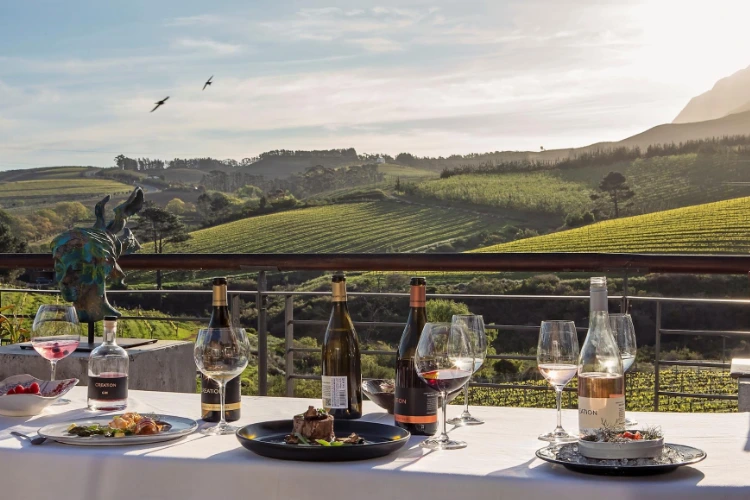
A helicopter lands directly at a private wine estate where lunch has already been prepared.
Others continue to a secluded coastal villa inaccessible by conventional transport.
Some choose to arrive at a championship golf course overlooking False Bay.
The journey becomes part of the destination rather than simply the route between places.
That is the quiet beauty of aviation.
It removes distance.
It creates possibilities.
The Calm Above the City
There is an unexpected stillness inside a helicopter.
The city continues below.
Traffic moves through the streets.
Boats cross the harbour.
People gather on beaches.
Yet inside the cabin, everything slows.
Conversations become quieter.
The landscape commands attention.
Even those who usually reach instinctively for a camera often find themselves simply looking.
Sometimes the most memorable photographs are the ones never taken.
Returning to Earth
Every flight eventually returns to the Waterfront helipad.
The city resumes its familiar pace.
Restaurants fill.
Traffic increases.
The mountain once again towers above the skyline.
Yet something has changed.
Guests often recognise landmarks they passed only hours earlier.
Roads feel more familiar.
Neighbourhoods connect in ways they hadn’t previously understood.
Cape Town becomes easier to navigate because it has first been understood from above.
Perspective Is the Greatest Luxury
Luxury is often associated with exclusivity.
Private villas.
Fine dining.
Rare wines.
Yet perspective may be the greatest privilege of all.
To rise quietly above one of the world’s most beautiful cities is not simply to admire it.
It is to understand how every coastline, mountain range and valley belongs to a single landscape.
From the air, Cape Town becomes less a collection of famous landmarks and more a place of remarkable harmony.
That understanding remains long after the helicopter has landed.
Seeing the Cape Differently
Every visitor remembers their first glimpse of Table Mountain.
Few remember the exact route they drove into the city.
A helicopter offers something rarer.
It replaces a familiar postcard with an entirely new memory.
Not because it reaches places inaccessible by road.
Because it reveals relationships impossible to appreciate from the ground.
The Atlantic wrapping around the Peninsula.
The vineyards sheltered beneath mountain ranges.
The city balanced delicately between sea and stone.
Sometimes changing your perspective is enough to change the journey itself.